Introduction
This documentation provides a summary of a re-run of experiment run 58 performed at the K100 Detector Testing Facility at the University of Minnesota (UMN). The main goal of the run was to measure the charge collection efficiency. We also had additional goals of determining the maximum bias voltage before breakdown and neutralizing the detector under bias after a certain duration.
Dr. Mei and his team grew the germanium crystal, “USD1,” at the University of South Dakota. Then, a team at Texas A&M polished and fabricated the crystal with ionization readout channels. Finally, the detector was wire bonded, mounted in a dilution fridge and tested at UMN.
// Dataset summary (Matt)
// Peaks summary (Nick)
Detector and Sources
We tested a germanium detector that is 32mm thick and 100mm in diameter. Details of the crystal properties can be found here. We used four Americium-241 (Am-241) sources mounted above each channel on the detector (see Figure 1). The pinholes allow 60keV gammas through to the detectors. Alphas from the sources are blocked by the source encapsulation.
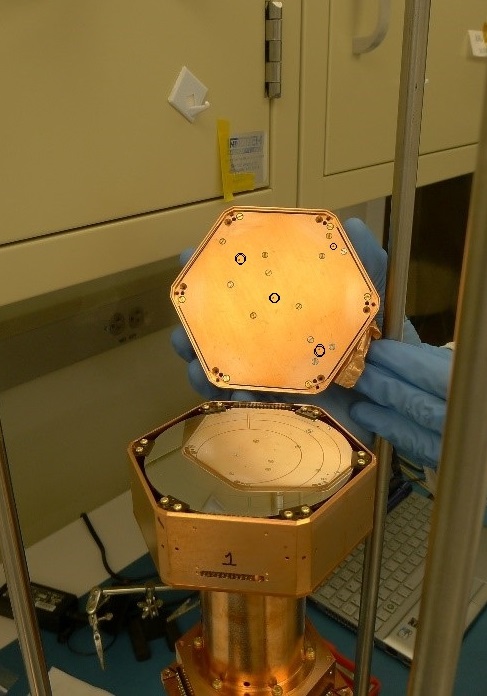
Figure 1: Shows the orientation of the 4 Am-241 source plates before it was installed on the detector
We observed 60keV peaks in spectra from each channel and performed different measurements over a course of two-weeks. We used the data masured at various bias voltages to characterize the charge collection efficiency as a function of bias for each channel, and studied how the charge collection efficiency varies with time under bias.
Data Analysis
| # | Analysis Topic | Name |
|---|---|---|
| 0 | Plots of 60 keV Peak time dependence | Matt Fritts |
| 1 | 60 keV Peak Parameters | Nick Mast |
| 2 | Notes on a model for increasing impact ionization rate | Matt Fritts |
| 3 | Physical Impact Ionization Model | Nick Mast |
| 4 | Rates and Physical Impact Ionization Model | Matt Fritts |
| 5 | A Look at the Falloff Time | Matt Fritts |
Summary
--